7 Easy Marketing Automation Tools to Skyrocket Efficiency in 2026

In today’s fast-paced digital landscape, marketers are constantly searching for ways to do more with less. Sound familiar? If you’re drowning in repetitive tasks and struggling to keep up with customer demands, you’re not alone. This is exactly why marketing automation tools have become the backbone of successful marketing strategies worldwide.
Marketing automation tools streamline repetitive tasks like lead nurturing, email campaigns, and customer segmentation, allowing teams to focus on strategy and growth. In 2026, these marketing automation tools are essential for boosting efficiency, with studies showing a 14.5% increase in sales productivity and 12.2% reduction in marketing overhead, making them ideal for driving precise, high-ROI campaigns.
What Exactly Are Marketing Automation Tools?
Marketing automation tools are sophisticated software platforms that take the manual labor out of marketing. Think of them as your digital marketing assistant that never sleeps, automatically handling tasks that would otherwise consume hours of your team’s valuable time.
These platforms automate repetitive marketing tasks such as:
- Creating and managing personalized email sequences
- Segmenting audiences based on behavior and preferences
- Scheduling and publishing social media content
- Generating detailed analytics reports
- Nurturing leads through the sales funnel
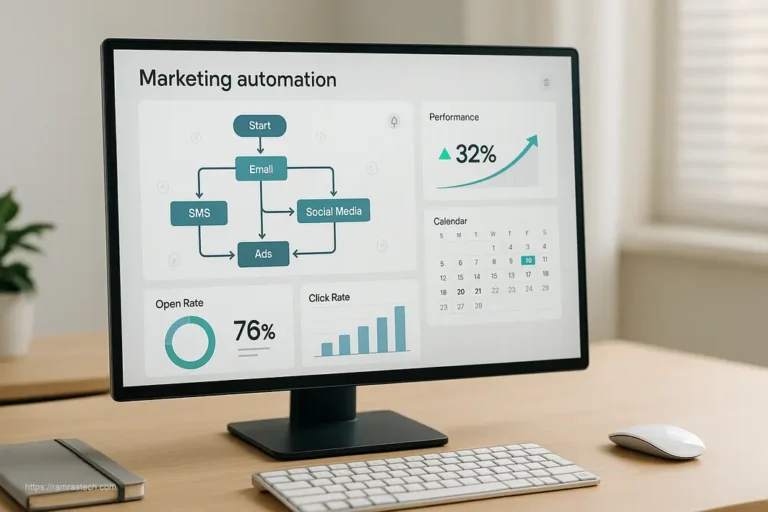
What makes them truly powerful is their ability to unify customer data from multiple sources, coordinate journeys across channels (email, SMS, web chat, social media), and leverage AI for hyper-personalization across the entire customer lifecycle.
The benefits are substantial and measurable. Companies using marketing automation see significant time savings on manual work, drastically improved campaign precision through predictive analytics and dynamic segmentation, and higher ROI—with studies showing nurtured leads yielding an impressive 451% more qualified prospects and 47% larger purchases on average.
How to Choose the Right Marketing Automation Tool for Your Business
Selecting the ideal marketing automation tool isn’t a one-size-fits-all proposition. Your decision should be guided by several critical factors:
1. Budget Considerations
Pricing structures vary widely from free plans with limited features to enterprise solutions costing thousands monthly. The good news? There are excellent options at every price point in 2026.
2. Must-Have Features
Assess which capabilities are non-negotiable for your specific needs:
- AI-powered content generation and optimization
- Multi-channel campaign management
- Seamless CRM integration (especially with platforms like Salesforce)
- Lead scoring and segmentation capabilities
- Analytics and reporting depth
3. Ease of Use
Look for no-code or low-code platforms if your team lacks technical expertise. Many modern tools offer intuitive interfaces with drag-and-drop functionality that don’t require development skills.
4. Scalability Potential
Will the platform grow with your business? This is particularly important for multi-location businesses or companies expecting significant expansion.
5. Strategic Alignment
Ensure the tool supports your specific business model and goals:
- E-commerce businesses should prioritize tools with strong omnichannel messaging capabilities
- Multi-location brands need platforms that can manage location-specific automation
- B2B companies typically require robust lead scoring and nurturing features
Above all, look for tools with strong analytic capabilities to track ROI and compliance features that protect your business in an increasingly regulated digital landscape.
Top 7 Marketing Automation Tools Dominating 2026
After analyzing dozens of platforms, these seven marketing automation tools stand out in 2026 for their exceptional AI integration, scalability options, and proven efficiency gains:
1. Birdeye: The Multi-Location Powerhouse
Key Features:
- AI agents specifically designed for local listings optimization
- Automated messaging and lead generation across locations
- Centralized surveys and NPS collection
- Unified review management and data aggregation for multi-site businesses
Why It Shines: Birdeye excels at scaling for brands with multiple locations, automating compliance and personalization at the enterprise level. Their unified dashboard gives marketing teams unprecedented visibility across all locations.
Potential Drawbacks: The platform is oriented toward multi-site operations, which might be overwhelming for single-location small businesses.
Perfect For: Multi-location enterprises like retail chains, franchise operations, and businesses with distributed footprints.
Ready to unify your locations under one powerful automation platform? Sign up for Birdeye’s free trial and start automating your growth today.
2. Salesmanago: The AI-Driven Personalization Expert
Key Features:
- Sophisticated omnichannel messaging capabilities
- AI-powered product and content recommendations
- Advanced web personalization capabilities
- Unified customer profiles via their comprehensive Growth Framework
Why It Shines: Their AI-driven decisioning systems reduce marketing guesswork significantly, making it ideal for startups scaling quickly in competitive markets.
Potential Drawbacks: Less tech-savvy teams might face a steeper learning curve with some of their more advanced features.
Perfect For: E-commerce startups looking to implement enterprise-level personalization without enterprise-level resources.
Want to see how AI-powered personalization can transform your customer journeys? Start with Salesmanago’s interactive demo and boost your conversion rates today.
3. Boltic: The No-Code Automation Specialist
Key Features:
- No-code AI workflow creation
- Intelligent agents that handle routine tasks
- Real-time tracking and performance measurement
- Secure reporting and compliance documentation
Why It Shines: Boltic stands out for its remarkably easy setup process and precise lead/customer journey tracking capabilities.
Potential Drawbacks: Focuses more on automation basics rather than offering the comprehensive suite of features found in all-in-one platforms.
Perfect For: Small teams and agencies needing quick automation wins without extensive technical setup.
Looking to automate your marketing chores without coding? Try Boltic’s no-code platform free and start tracking your ROI instantly.
4. Zapier: The Integration Champion
Key Features:
- AI orchestration across thousands of applications
- Connects disparate tools for custom workflow creation
- Enables seamless email, SMS, and CRM integrations
- Automation templates for common marketing workflows
Why It Shines: Zapier offers unmatched flexibility with affordable integration options that don’t require coding experience.
Potential Drawbacks: Relies on third-party apps and isn’t a standalone marketing platform by itself.
Perfect For: Agencies and freelancers looking to automate complex multi-tool stacks without custom development.
Ready to connect your marketing ecosystem? Build your first Zap on Zapier today and upgrade for unlimited automations when you’re ready.
5. Brevo: The All-in-One Starter Solution
Key Features:
- Comprehensive email and SMS marketing capabilities
- Intelligent audience segmentation
- Integrated analytics and performance tracking
- Affordable scaling options for growing businesses
Why It Shines: Brevo (formerly Sendinblue) offers cost-effective solutions for beginners that provide comprehensive features without overwhelming complexity.
Potential Drawbacks: Lacks some of the more advanced enterprise-level features found in premium platforms.
Perfect For: SMBs and e-commerce businesses just starting their automation journey.
Want to automate your first campaign without breaking the bank? Get started with Brevo’s generous free plan and see results in minutes.
6. HubSpot: The Premium All-in-One Solution
Key Features:
- Fully integrated CRM, email, and ads management
- Advanced AI personalization capabilities
- Comprehensive analytics and reporting
- Extensive integration marketplace
Why It Shines: HubSpot offers a robust free tier that scales beautifully to enterprise-level needs with deep analytics capabilities.
Potential Drawbacks: Premium features can add up in cost as you scale and add additional capabilities.
Perfect For: Growing businesses and mid-market companies looking for a platform that can scale with their needs.
Curious about what HubSpot can do for your marketing efforts? Explore their free tools and upgrade only when you need more automation power.
7. Omnisend: The E-commerce Specialist
Key Features:
- E-commerce-focused email and SMS automation
- Intelligent product recommendations
- Pre-built workflow templates for online stores
- Advanced segmentation based on shopping behavior
Why It Shines: Omnisend is specifically tailored for online retailers, offering personalization capabilities that drive exceptional ROI for e-commerce businesses.
Potential Drawbacks: Its specialized nature means it’s primarily valuable for e-commerce rather than serving as a general-purpose tool.
Perfect For: Online retailers and e-commerce startups seeking specialized automation.
Ready to revolutionize your e-commerce marketing? Launch Omnisend’s free trial to skyrocket your store’s efficiency today.
The Game-Changing Benefits of Marketing Automation
When implemented correctly, automated marketing solutions transform how businesses connect with customers while dramatically improving operational efficiency.
Time and Resource Optimization
Marketing automation handles the heavy lifting of routine tasks, including:
- Lead scoring and qualification
- Multi-stage drip campaigns
- A/B testing at scale
- CRM data synchronization and handoffs
This liberation from tedious manual processes allows your creative team members to focus on strategy and content creation—areas where human insight still outperforms AI. The savings are substantial, with businesses reporting an average of 15-20 hours saved weekly per marketing team member.
Enhanced Tool Synchronization
One of the most underrated benefits is how automation creates harmony between your marketing tools. Rather than operating in silos, your email platform, CRM, social media tools, and analytics suites work in concert. This synchronization eliminates data inconsistencies that plague manually operated marketing stacks.
Adaptation to Emerging Trends
Modern marketing automation tools are designed to adapt to evolving consumer behaviors:
- Leveraging AI-generated interactions that feel genuinely personal
- Employing predictive analytics to anticipate customer needs
- Utilizing dynamic segmentation that evolves with your audience
This is increasingly critical as consumer expectations rise—with recent data showing 81% of reviews on Google directly reference response speed and personalization as key factors in customer satisfaction.
Real-World Success Stories
The impact of proper automation is measurable and significant:
- Multi-location brands using centralized automation report 35% higher consistency in brand messaging across locations
- Companies implementing lead nurturing automation see 451% more qualified prospects reaching sales teams
- Automated personalization drives 26% higher average order values in e-commerce settings
The Future of Marketing Automation: What’s Coming Next
As we look toward the horizon, several transformative trends are reshaping what marketing automation tools can accomplish:
The Rise of AI Agents and Orchestration
In 2026, the most advanced platforms are emphasizing:
- AI agents that make autonomous decisions about subject lines, send times, and content variations
- Agentic platforms capable of handling massive data volumes and complex compliance requirements
- No-code orchestration systems that manage customer journeys across multiple channels (SMS/MMS, social, email, and digital ads)
Technological Evolution Driving New Capabilities
Advances in machine learning are enabling previously impossible features:
- Hyper-personalization that adapts to individual behavior patterns in real-time
- Predictive lead scoring that identifies high-value prospects with unprecedented accuracy
- AI-generated content that matches brand voice while optimizing for conversion
These capabilities prepare businesses for the next frontier of marketing—where AI-driven discovery becomes the primary way customers find products and services. Companies adopting these technologies now will establish competitive advantages that late adopters will struggle to overcome.
Implementing Marketing Automation: Best Practices
To maximize your return on investment with marketing automation tools, follow these implementation guidelines:
Start With Clear Objectives
Before selecting any platform, define exactly what you want to achieve:
- Are you primarily focused on lead generation?
- Is customer retention your main concern?
- Do you need to integrate online and offline customer data?
Clear goals prevent the common pitfall of implementing powerful automation without a strategic purpose.
Begin With High-Impact, Low-Complexity Workflows
The most successful implementations start small and expand gradually:
- Automate welcome email sequences for new subscribers
- Implement abandoned cart recovery for e-commerce
- Create basic lead scoring to prioritize sales outreach
Once these foundational elements are working smoothly, you can expand to more sophisticated use cases.
Invest in Proper Training and Adoption
The most powerful platform will underperform if your team doesn’t embrace it. Allocate resources for:
- Comprehensive training on your chosen platform
- Documentation of standard operating procedures
- Regular check-ins to identify adoption challenges
Monitor, Test, and Optimize Continuously
Automation is never “set and forget.” Establish regular review cycles to:
- A/B test critical automation sequences
- Review performance metrics against benchmarks
- Update customer journey maps based on new behavioral patterns
FAQs About Marketing Automation Tools
How much do marketing automation tools typically cost?
Pricing ranges widely from free plans with basic features to enterprise solutions costing $2,000+ monthly. Most SMBs find suitable options in the $200-$500 monthly range, while mid-market companies typically invest $500-$1,500 monthly for more robust capabilities. Enterprise-level automation with advanced AI features and multi-site management can exceed $2,000 monthly but typically delivers proportional ROI.
Can small businesses benefit from marketing automation, or is it only for large enterprises?
Absolutely! Small businesses often see the highest proportional ROI from marketing automation. With limited staff, the time savings are particularly valuable. Platforms like Brevo and Zapier offer affordable entry points with powerful features that scale as your business grows. The key is selecting a platform aligned with your specific needs rather than overpaying for unused enterprise features.
How long does it typically take to implement a marketing automation platform?
Basic implementation can be completed in 2-4 weeks for straightforward use cases. However, comprehensive enterprise implementations integrating with complex tech stacks typically require 2-3 months for full deployment. The most successful implementations follow a phased approach, launching core automations first before expanding to more sophisticated workflows.
What’s the relationship between CRM and marketing automation tools?
CRM (Customer Relationship Management) systems store customer data and manage sales interactions, while marketing automation platforms execute and optimize marketing activities. They’re complementary technologies that work best when integrated. Many platforms like HubSpot offer both capabilities in one system, while others like Salesmanago specialize in connecting to existing CRMs like Salesforce to create a complete customer data ecosystem.
How do I measure the ROI of marketing automation?
Effective ROI measurement requires tracking both cost savings and revenue generation:
- Calculate time saved by automating manual processes (team hours × average hourly cost)
- Measure increased conversion rates at each pipeline stage
- Track revenue attributed to automated campaigns
- Monitor customer retention improvements
The most accurate assessments compare performance metrics before and after automation implementation while accounting for all platform costs including software, implementation, and maintenance.
Conclusion: The Future Is Automated
Investing in the right marketing automation tools delivers three critical advantages: operational efficiency, higher marketing ROI, and scalable personalization tailored to your specific business needs. Whether you’re a startup looking to punch above your weight or an enterprise seeking to coordinate complex multi-channel campaigns, today’s automation landscape offers solutions designed for your goals.
The key is making an informed choice based on your specific requirements rather than simply following industry trends. Take the time to evaluate options like Birdeye for multi-location management, Salesmanago for AI-driven personalization, or Zapier for flexible integration capabilities.
Ready to transform your marketing operations? Explore automation strategies that can dramatically improve your efficiency and results. For deeper guidance, check out free implementation webinars from platforms like HubSpot or Salesmanago to jumpstart your automation journey.
Remember, the most successful automation strategies begin with clear objectives and grow incrementally. By starting your automation journey today, you position your business to thrive in an increasingly competitive landscape where personalized, timely marketing becomes the minimum expectation rather than a competitive advantage.