Digital Marketing Automation Hacks for 2026 Success
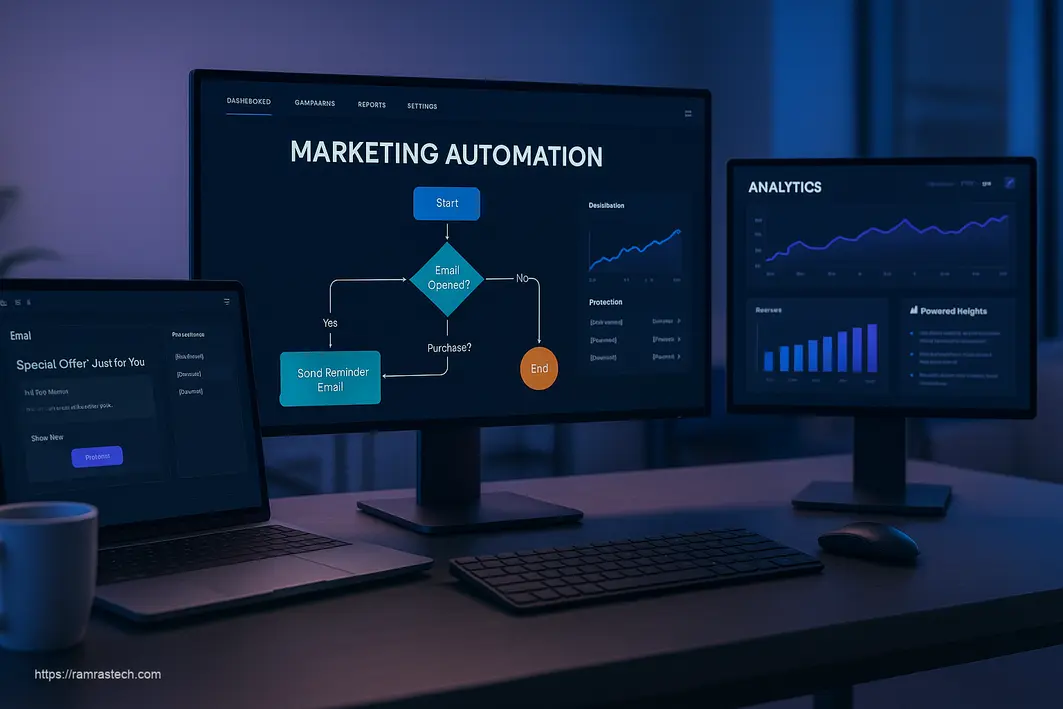
Ever wondered how some businesses seem to be everywhere at once, responding instantly to customers while your team is drowning in spreadsheets and manual tasks? The secret weapon revolutionizing digital marketing isn’t just another buzzword—it’s marketing automation hacks that smart businesses are leveraging to stay competitive in 2026’s hyper-connected landscape.
Think about this: companies using marketing automation are seeing a 14.5% increase in sales productivity while simultaneously reducing marketing overhead by 12.2%. Small businesses implementing these techniques are experiencing a mind-blowing 451% increase in qualified leads. These aren’t just incremental improvements—they’re business-transforming results.
Let’s dive into the practical automation strategies that can revolutionize how your business connects with customers, streamlines operations, and drives measurable revenue growth—without requiring a massive team or budget.
What Makes Marketing Automation Essential in 2026?
Marketing automation uses integrated software and data to automate, coordinate, and measure cross-channel marketing across the customer lifecycle. But what’s different in 2026 is the shift from occasional campaigns to continuous, behavior-driven customer journeys guided by real-time data.
The most innovative change? We’ve moved beyond predefined workflows to autonomous systems that continuously learn, adapt, and execute without constant manual intervention. Today’s automation platforms don’t just follow instructions—they evolve based on performance data, making micro-adjustments to optimize results continuously.
“Marketing automation isn’t just about scheduling emails anymore,” explains digital marketing strategist Megan Chen. “In 2026, it’s about creating intelligent systems that adapt to customer behavior faster than humans ever could.”
For businesses facing increased competition and tightening budgets, automation provides the ability to maintain personalized connections with customers at scale—something impossible to achieve manually without significant overhead.
Hack #1: Implement Behavioral Trigger Systems That Learn and Evolve
The most powerful marketing automation hack isn’t about setting up static workflows—it’s about creating systems that evolve based on customer responses. Behavioral triggers are rules that automatically initiate marketing actions based on specific user behaviors or characteristics.
Here’s how to implement this effectively:
- Map critical customer journey moments where immediate response adds value
- Set up progressive profiling to build customer knowledge over time rather than all at once
- Create adaptive response mechanisms that adjust based on engagement patterns
- Implement AI-powered optimization that tests different approaches automatically
For example, when a prospect downloads your whitepaper, don’t just send a standard follow-up email. Instead, implement a system that analyzes how they engaged with the content (which pages they spent time on, which links they clicked) and customizes the follow-up sequence accordingly.
“We saw conversion rates jump 37% after implementing behavioral triggers that adapted based on prospect engagement patterns,” shares marketing director James Wilson. “The system actually gets smarter with each interaction.”
This approach moves beyond simple automation to create truly responsive marketing that feels personalized to each prospect.
Hack #2: Supercharge Lead Nurturing Through Multi-Channel Automation
Lead nurturing automation represents one of the highest-ROI applications of marketing automation technology. By automating the many steps between initial marketing contact and sales engagement, your team gains precious time to focus on prospects showing genuine promise.
The most effective lead nurturing systems in 2026 operate across multiple channels simultaneously, creating a cohesive experience regardless of how prospects engage with your brand. Here’s how to implement this:
- Implement trigger-based marketing messages that respond immediately to prospect actions
- Create drip-feed campaigns across email, SMS, and messaging apps based on engagement
- Develop personalized content delivery adapted to individual prospect behavior
- Set up automated lead scoring that assigns numeric values based on engagement patterns
- Integrate retargeting ads that align with nurturing stages
What makes multi-channel nurturing particularly effective is the reinforcement effect. When prospects receive consistent messaging across different touchpoints, brand recall and message retention dramatically improve. This approach enables you to launch hyper-targeted campaigns that nurture every lead with personalized messaging, ensuring no prospects fall through the cracks.
Integrating your lead nurturing with your digital marketing strategies creates a powerful synergy that accelerates prospect movement through your funnel.
Hack #3: Implement Smart Email Automation That Goes Beyond Scheduling
Email automation continues to deliver some of the highest ROI in digital marketing, but the basic scheduled newsletter is no longer enough. In 2026, effective email automation combines sophisticated personalization with strategic timing and content adaptation.
Here’s what works now:
Dynamic Content Blocks
Implement email templates with content sections that automatically adjust based on recipient data. This allows a single email campaign to display different information, offers, or imagery based on recipient attributes without creating multiple versions manually.
Behavioral Sequence Automation
Move beyond time-based sequences to behavior-based email flows:
- Abandoned cart recovery that adapts messaging based on product category and customer value
- Browse abandonment flows triggered when high-intent pages are visited without conversion
- Re-engagement campaigns that automatically vary offers based on previous interaction patterns
- Customer celebration sequences triggered by milestones in the customer relationship
Predictive Send-Time Optimization
Implement AI-powered send time optimization that learns when individual recipients are most likely to open and engage with emails, then automatically delivers messages during those windows.
“We increased email conversion rates by 23% simply by implementing predictive send-time optimization,” notes email marketing specialist Sarah Johnson. “Different customers engage at different times, and automation helps us hit those windows perfectly.”
By combining these approaches, you create email automation that feels remarkably personalized while requiring minimal ongoing management—the perfect balance of personalization and efficiency.
Hack #4: Seamless CRM Integration for Complete Customer Visibility
One of the most transformative marketing automation hacks is creating a truly unified view of customer interactions by integrating your automation platform with your Customer Relationship Management (CRM) system.
This integration eliminates the common problem of disconnected data across marketing and sales, enabling:
- Automated lead qualification based on engagement across all touchpoints
- Instant sales notifications when high-priority prospects show purchase intent
- Bi-directional data synchronization ensuring both teams work from current information
- Closed-loop reporting that tracks the entire customer journey from first touch to sale
“We wasted countless hours on manual data transfer between systems before implementing automated CRM integration,” explains sales operations manager David Chen. “Now our sales team instantly knows when a prospect is engaging with marketing materials, and marketing can see which campaigns are turning into actual revenue.”
This visibility enables what I call “conversation continuity”—the ability for sales to pick up conversations exactly where marketing left off, creating a seamless experience for prospects rather than the disjointed interactions that occur when systems don’t communicate.
For best results, focus on creating automated workflows that trigger based on changes in either system, such as automatically moving leads to different nurturing tracks when their status changes in the CRM.
Hack #5: Implement Workflow Optimization with Continuous Improvement
Efficient workflow design separates high-performing marketing automation from systems that create more problems than they solve. In 2026, the most effective marketing automation workflows incorporate continuous improvement mechanisms.
Here’s how to implement this approach:
- Start with clear process mapping to understand the current state of marketing and sales workflows
- Identify bottlenecks and manual touchpoints that create delays or inconsistency
- Design flexible workflows with decision points rather than rigid linear processes
- Build in performance monitoring and testing at key conversion points
- Implement automation that flags underperforming segments for review
“Many companies set up automation workflows once and never revisit them,” notes automation consultant Michael Lee. “The real power comes from creating systems that highlight opportunities for improvement automatically.”
For example, rather than just automating your lead scoring, implement a system that regularly analyzes which scoring factors actually correlate with conversion and suggests adjustments to your scoring model. This approach ensures your automation becomes more effective over time rather than gradually losing relevance.
Smart businesses are now creating dedicated workflow review cycles where automation performance is assessed and refined based on actual results, creating a continuous improvement loop that maximizes ROI.
Hack #6: Leverage Personalization at Scale Through Data Unification
The ability to deliver truly personalized experiences at scale represents one of marketing automation’s most valuable benefits. However, achieving this requires moving beyond basic mail-merge style personalization to data-driven customization across the customer journey.
The key is unifying customer data from multiple sources to create comprehensive profiles that inform personalization:
- Website behavior and content preferences
- Purchase history and product interests
- Email and content engagement patterns
- Support and service interactions
- Social media activity and preferences
When this data flows into a unified customer profile, you can implement personalization that goes far beyond adding first names to emails:
- Dynamically adaptive website experiences that highlight different products or content
- Personalized product recommendations based on behavioral patterns
- Custom nurturing paths determined by engagement history
“We increased conversion rates by 34% by implementing personalization based on unified data profiles,” shares e-commerce manager Jessica Zhang. “Customers respond dramatically better when content feels tailored specifically to their needs.”
The most effective approach combines explicit personalization (based on information customers provide directly) with implicit personalization (based on observed behaviors). This creates experiences that feel helpful rather than creepy while still delivering the relevance customers expect.
Integrating personalization with your content marketing strategies multiplies the effectiveness of both approaches.
Hack #7: Implement Conversational Marketing Automation
Conversational marketing represents one of the fastest-growing areas of marketing automation, leveraging chatbots and messaging apps to create interactive experiences that move prospects through the funnel in real-time rather than through drawn-out email sequences.
The most effective conversational marketing automation in 2026 combines:
- Intelligent chatbots that qualify prospects through natural conversation
- Automated meeting scheduling based on qualification criteria
- Personalized resource delivery during conversations
- Seamless handoff between automated and human interactions
“We reduced our sales cycle by 47% after implementing conversational marketing automation,” notes demand generation manager Alex Rivera. “Prospects get immediate responses to their questions, and our sales team only engages with qualified leads who are ready for conversation.”
The key to success is creating conversation flows that feel helpful rather than robotic. Modern conversational platforms can recognize intent, remember context across multiple interactions, and customize responses based on user attributes and behavior patterns.
For maximum impact, integrate your conversational automation with your CRM and other marketing automation tools to create a unified system where conversations influence email nurturing, ad targeting, and sales outreach.
Hack #8: Implement Cross-Channel Campaign Orchestration
One of the most powerful marketing automation hacks is implementing true cross-channel campaign orchestration—coordinating messages across multiple platforms based on a unified strategy rather than running siloed campaigns on each channel.
Effective cross-channel orchestration requires:
- Unified customer identity across all platforms and touchpoints
- Centralized campaign planning with channel-specific execution
- Synchronized messaging and timing across channels
- Cross-channel attribution to understand how channels influence each other
“We increased conversion rates by 42% after implementing true cross-channel orchestration,” shares digital marketing director Carlos Rodriguez. “The compound effect of coordinated messaging across email, social media, ads, and our website created momentum that single-channel campaigns never achieved.”
The most sophisticated orchestration systems in 2026 use AI to determine not just what message to send, but which channel is most likely to drive engagement for each specific customer at any given moment. This adaptive approach ensures resources are allocated to the channels most likely to drive results for each segment.
Implementing cross-channel orchestration creates a cohesive brand experience while maximizing the impact of your marketing investments across all platforms.
Hack #9: Leverage Predictive Analytics for Proactive Engagement
Predictive analytics represents a quantum leap in marketing automation capabilities, enabling proactive engagement based on anticipated customer needs rather than just reactive responses to behavior.
Here’s how innovative companies are implementing predictive capabilities:
- Churn prediction models that identify at-risk customers before they leave
- Purchase propensity scoring that highlights which products customers are most likely to buy next
- Optimal contact time prediction that determines when customers are most receptive
- Content affinity analysis that forecasts which topics will resonate with each segment
“Implementing predictive analytics improved our retention rates by 28% by allowing us to proactively address customer needs before they became problems,” explains customer success manager Rachel Kim. “We’re now having conversations with customers before they even realize they have questions.”
What makes predictive capabilities particularly powerful is their ability to guide resource allocation. Rather than spreading attention evenly across all customers, predictive systems help you focus on high-value opportunities and potential problems that need attention.
While implementing predictive analytics traditionally required significant data science resources, modern marketing automation platforms now offer accessible predictive capabilities that marketing teams can leverage without specialized expertise.
Hack #10: Automate Performance Optimization with AI
The ultimate marketing automation hack is implementing systems that not only execute campaigns but actively optimize them without constant human intervention. AI-powered optimization represents the frontier of marketing automation in 2026.
Here’s how leading companies are implementing this approach:
- Automated A/B testing that continuously tests variations and implements winners
- Dynamic budget allocation that shifts spending to higher-performing channels in real-time
- Content optimization engines that refine messaging based on engagement patterns
- Segment discovery and refinement that identifies new audience opportunities automatically
“We increased ROAS by 52% after implementing AI-powered optimization across our campaigns,” notes performance marketing manager Olivia Thompson. “The system makes thousands of micro-adjustments that would be impossible for our team to execute manually.”
The most advanced systems now employ reinforcement learning approaches that optimize for long-term objectives rather than just immediate conversions, creating sustainable growth rather than short-term gains that might damage customer relationships.
While complete automation isn’t the goal—human creativity and strategy remain essential—these systems dramatically amplify the impact of marketing teams by handling the complex, data-driven optimization that humans struggle to manage effectively.
FAQs About Marketing Automation Hacks
What marketing automation tasks deliver the highest ROI?
Lead nurturing, email sequence automation, and behavioral triggers consistently deliver the highest ROI for most businesses. These applications directly impact revenue by improving conversion rates and accelerating sales cycles while requiring minimal ongoing maintenance once properly configured.
How much does implementing marketing automation typically cost?
Implementation costs vary widely based on platform selection, complexity, and existing systems. Entry-level automation tools start around $200/month for small businesses, while enterprise solutions range from $2,000-$4,000/month. Beyond subscription costs, account for implementation services ($5,000-$25,000) and possible integration development. Most businesses achieve positive ROI within 6-12 months of proper implementation.
Can small businesses effectively use marketing automation?
Absolutely! Small businesses often see the most dramatic benefits from marketing automation, with research showing a 451% increase in qualified leads for SMBs implementing lead nurturing automation. Modern platforms offer scalable solutions with pricing tiers appropriate for smaller organizations. The key is starting with focused applications that address your most pressing needs rather than attempting to automate everything simultaneously.
What’s the biggest mistake companies make with marketing automation?
The most common mistake is focusing on technology implementation without first establishing clear processes and strategies. Automation amplifies existing processes—if those processes are flawed, automation will simply produce poor results more efficiently. Start by mapping your ideal customer journeys and identifying genuine bottlenecks before selecting and implementing automation tools.
How do you measure the success of marketing automation initiatives?
Effective measurement looks beyond activity metrics to impact metrics. Key measurements include changes in conversion rates at each funnel stage, reduction in cost per acquisition, improvement in lead quality (as measured by sales acceptance rates), decrease in sales cycle length, and ultimately revenue growth attributable to automated campaigns. Establish baseline measurements before implementation to accurately track improvements.
Conclusion
Marketing automation hacks deliver substantial benefits across efficiency, revenue growth, and customer experience. By implementing these strategies—from behavioral triggers and lead nurturing to cross-channel orchestration and predictive analytics—you position your organization to achieve the 14.5% productivity increase and 12.2% overhead reduction that industry research demonstrates.
The shift in 2026 toward autonomous, learning systems means that your automation investments will become smarter and more effective over time, requiring less manual adjustment while delivering increasingly personalized customer experiences at scale.
The question isn’t whether you should implement marketing automation—it’s which of these high-impact hacks will deliver the most immediate value for your specific business challenges. Consider starting with lead nurturing or email automation—both offer quick wins and measurable ROI—and then expanding your automation footprint as you validate results.
Which of these marketing automation hacks resonates most with your current business challenges? Have you already implemented some of these approaches? Share your experiences in the comments below—I’d love to hear about your automation journey.